
Data center acceptability: moving past a caricatured debate

Everyone wants water from the tap. Nobody wants the water tower at the bottom of their garden.
Data centers live with exactly that paradox. We rely on them hundreds of times a day without thinking about it, to pay by card, check a medical record or send a quote. But as soon as a project breaks ground, the question becomes: why here, and what for?
On November 6 and 7, 2026, a European coalition is calling for protests under the banner "Stop Dirty Data Centres". In France, gatherings are planned in Aubervilliers, Vitry-sur-Seine, Fouju, Tigery, Marseille and Rantigny. The debate is legitimate. But it often lumps together very different realities: a gas-powered AI campus in Texas and a colocation facility near Paris hosting the servers of a mutual insurer are not the same thing.
⚡ The short answer
A data center doesn't become acceptable by decree. Acceptability rests on transparency about what it consumes, how well it fits its local area, and how useful the workloads it hosts really are. In France, data centers account for 2.2% of electricity consumption (2025, France Datacenter / EY-Parthenon 2026 barometer), on a power mix that is more than 95% low-carbon (RTE, 2025 electricity report), and 0.002% of water withdrawals, or 681,000 m³ in 2024 out of roughly 30 billion m³ (IntoTheMinds). That's a long way from US orders of magnitude, and the EU framework now requires annual reporting, followed by an A to G energy and water label.
This article sorts things out: what opponents are actually asking for, why Europe is not the United States, what data centers are really used for, and why renaming a building changes nothing about what it consumes.
1. What the campaign is really asking for
The demand is simple and radical: an immediate moratorium on large data centers in Europe. In other words, a pause on construction until a democratic debate has settled the needs, locations and conditions for developing this infrastructure.
The argument draws on several registers at once. There's the environment (electricity, water, land take, e-waste), the local area (noise, loss of natural spaces, competition for land and grid connections), democracy (opacity, consultation seen as inadequate, Big Tech lobbying) and finally a broader critique of AI: surveillance, military uses, effects on mental health.
In France, the targets are concrete. In Fouju (Seine-et-Marne), the Stop Campus IA collective is fighting a project of 11 data centers on 90 hectares of farmland. In Rungis and Wissous, residents point to the lack of any cumulative environmental assessment for four neighboring projects. In Loon-Plage, the target is the site being considered by SoftBank and Schneider Electric.
Key question: Reread the campaign page: the phrase that keeps coming back is "AI data centres". The real target is hyperscalers and mega-campuses built for AI. The problem is that a moratorium on "large data centers" makes no such distinction.
That's exactly where the debate gets blurry. The concerns raised are often well founded, but they rely largely on figures, technologies and business models imported from across the Atlantic.
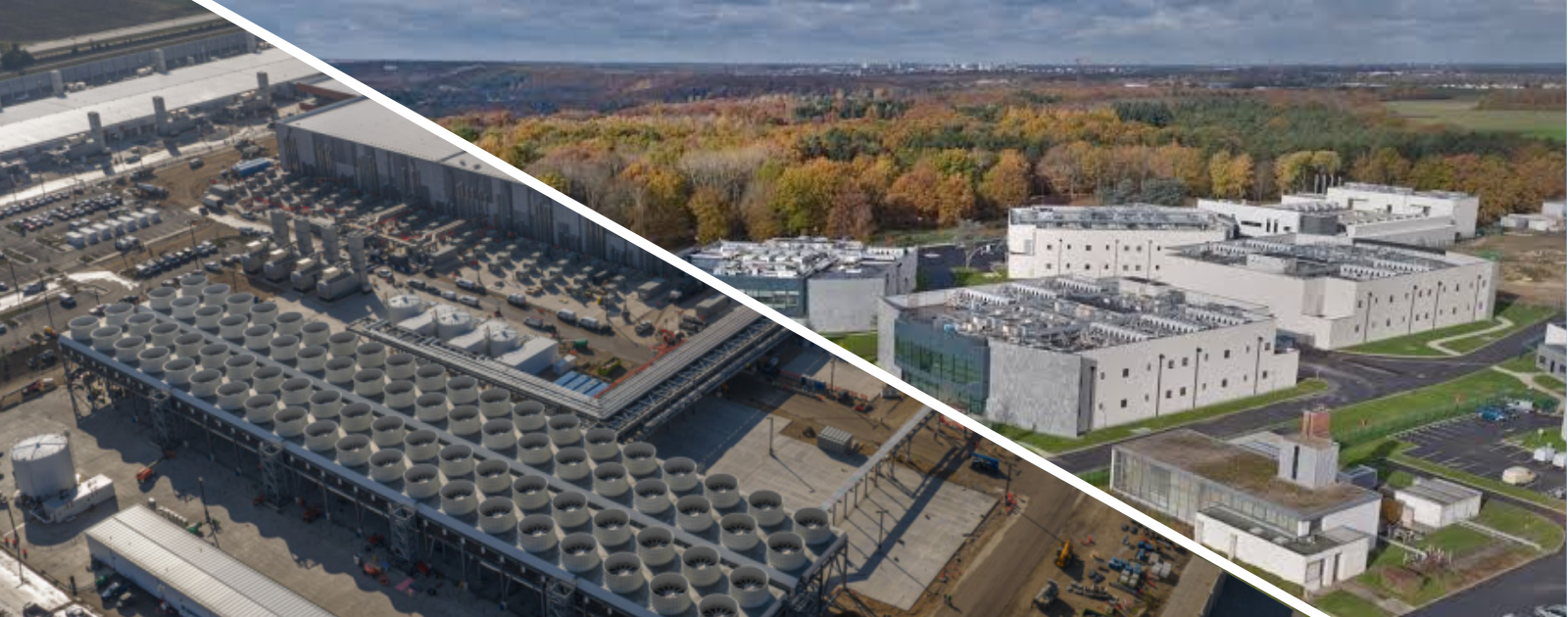
2. An American data center is not a European data center
Comparing the two is a bit like judging a municipal swimming pool's water use by looking at a golf course in the middle of the desert. Same family of use, completely different context.
In the United States, Lawrence Berkeley National Laboratory (LBNL) estimates that data centers used 176 TWh in 2023, or 4.4% of the country's electricity. Its projections for 2028 range from 6.7% to 12%. On water, the same report puts direct consumption at around 66 billion liters in 2023, with nearly 800 billion more liters used indirectly through electricity generation.
Some sites attract most of the criticism. Google reports that its data center in Council Bluffs, Iowa, used about 3.8 billion liters of water in 2024. That's the kind of figure that circulates in European media, often without any mention of where it comes from.
Why water doesn't weigh the same
The difference starts with cooling technology. An evaporative system circulates cold water that absorbs heat from the servers and then evaporates: the water is consumed, and consumption rises when it's hot. A closed-loop system circulates the same water over and over, cooled by chillers or outside air: very little is withdrawn.
In France, 71% of facilities already use closed-loop cooling, a share that could reach 81% within five years according to the France Datacenter / EY-Parthenon 2026 barometer.
| Indicator | United States | France |
|---|---|---|
| Share of national electricity use | 4.4% (2023), 6.7 to 12% projected for 2028 | 2.2% (2025) |
| Direct water consumption | ~66 billion liters (2023) | 0.002% of national withdrawals (2024) |
| Dominant cooling | Evaporative, widespread on large campuses | 71% closed-loop |
| Electricity | Mix varies by state | 95% low-carbon mix |
Sources: LBNL 2024 for the United States; France Datacenter / EY-Parthenon 2026 barometer for France. Measurement scopes differ, but the orders of magnitude speak for themselves.
Did you know? "Indirect" water exists in France too: part of the nuclear fleet is cooled by cooling towers. The real difference is carbon. A French kWh emits very little CO₂, which radically changes the footprint of a data center built here rather than elsewhere.
Europe isn't uniform either
Let's be honest: the problem exists on this side of the Atlantic too. In Ireland, data centers used 23% of the country's metered electricity in 2025, up from 5% in 2015, according to the Central Statistics Office (CSO). That level of concentration around Dublin puts real strain on the grid.
So the point isn't "virtuous Europe versus wasteful America". It's that you can't judge a project without looking at its local area, its power grid and its cooling technology.
3. A tightening EU framework (and that's a good thing)
The idea of a sector growing without rules doesn't hold up in Europe. It holds up even less now that the framework has tightened considerably over the past two years.
Mandatory reporting since 2024
Article 12 of the EU Energy Efficiency Directive (EED, Directive 2023/1791) requires every data center with at least 500 kW of installed IT power to report its performance to a European database each year: energy consumption, PUE (Power Usage Effectiveness, the ratio between the site's total energy use and the energy actually used by IT equipment), water consumption, waste heat reuse, share of renewables. The 500 kW threshold is low: it covers far more than hyperscalers.
An A to G label from 2027
On September 21, 2026, the European Commission adopted a delegated regulation creating a common rating scheme for data centers. Just like a fridge or a home energy certificate, each site will get one letter from A to G for energy (based on PUE) and another for water (based on WUE, Water Usage Effectiveness, the liters consumed per IT kWh). The first labels are expected in 2027. We covered how it works in our article on the data center energy label.
Next steps are already under way: a public consultation on mandatory minimum performance standards (energy, water, heat, grid support) runs until December 14, 2026, and a legislative proposal is announced for the second quarter of 2027.
Key point: The scheme has its limits, and they're worth knowing. The Commission itself acknowledges that compliance with the reporting obligation is still incomplete. And the label will publish efficiency ratios, not the total volumes of water or electricity each site consumes. A large, highly efficient site can therefore get a good rating while still weighing heavily on a local grid.
ISO 50001 and management standards: a European culture
Beyond legal obligations, energy management is widely standardized in Europe. ISO 50001 defines an energy management system: you measure, set targets, correct, and start again. Germany has even made it mandatory: its Energy Efficiency Act (EnEfG) requires data centers above 300 kW to implement ISO 50001 or an equivalent system, with certification mandatory since January 2026 for sites above 1 MW.
On top of that come ISO 14001 (environmental management), the EN 50600 series dedicated to data center design and operation, and in France the regime for classified installations (ICPE), which covers most large sites, particularly because of their backup generators.
The results show in the numbers: in France, average PUE went from 1.67 in 2021 to 1.36 in 2025, a 19% improvement in four years.
4. Data centers aren't just for AI
Reducing data centers to AI is like reducing roads to sports cars. They're loud and they draw attention, but most of the traffic is vans, buses and ambulances.
AI dominates the conversation, and compute mega-campuses do raise real questions. But the vast majority of facilities in operation in France host far more ordinary workloads, ones nobody would want to see switched off.
Key point: A blanket moratorium on "large data centers" wouldn't make these needs disappear. It would move them: to ageing, less efficient in-house server rooms, or to sites outside Europe, running on more carbon-intensive power and subject to other legal systems. The impact wouldn't shrink, it would just become invisible.
It's also a matter of sovereignty. A data center located in France falls permanently under French law, the French grid and French taxation. Refusing this infrastructure here means accepting greater dependence on infrastructure located elsewhere.
5. "Compute campus": when semantics replace evidence
Calling a coal plant an "energy park" doesn't make it any cleaner. Yet that seems to be the bet OpenAI is making.
In early November 2026, Business Insider reported that OpenAI wants the public and policymakers to stop saying "data centers" and adopt "compute campuses", or even "AI compute campuses". A spokesperson justified the choice by saying the term better describes the scale and role of this infrastructure, presented as a long-term investment in compute, energy and skilled jobs. According to Axios, the vocabulary shift is part of a communications and lobbying push planned for after the US midterm elections, led by Chris Lehane, the company's head of global affairs.
The timing is no accident. In the United States, the image of data centers has deteriorated sharply: according to a survey cited by Gizmodo, only 4% of Americans believe they have a positive effect on the environment, electricity bills, local quality of life, jobs and tax revenue all at once.
The word "campus" doesn't cool a single server
"Campus" suggests lawns, students, a place open to the city. A site drawing several hundred megawatts is still a site drawing several hundred megawatts. PUE, water consumption and grid load don't change with the sign on the gate.
The French example says it all: the Fouju project is already called "Campus IA". That didn't stop a collective forming under the name... Stop Campus IA. Local residents aren't disarmed by vocabulary.
Did you know? The industry already won one battle of words, twenty years ago, with "cloud". A cloud is light, intangible, floating above everything. Part of today's distrust comes precisely from the late discovery that this cloud has concrete foundations, transformers and chillers.
To be fair, the battle of words is fought on both sides. "Dirty data centres", "energy vampires", "data factories": opponents choose their terms carefully too. In both cases, the label is there to steer judgment before the figures are even on the table.
The only credible answer is the opposite of diversion: publish verifiable indicators, site by site. That's exactly what the EU's A to G label will make possible.
6. Local concerns are legitimate: what builds acceptability
Brushing opponents aside would be a mistake. Questions about water, noise, farmland or grid connections are serious, and some have already sunk projects elsewhere in Europe.
Acceptability can't be imposed. It has to be built, and a few principles make the difference.
Consult before deciding, not after. A project unveiled once the land has been bought and the permit filed starts with a handicap. Elected officials and residents need early access to clear information: power requested, cooling technology, traffic, generator noise during tests.
Think at the scale of the area. When four projects cluster between Rungis, Wissous, Paray and Chevilly, the question is no longer just "is this site compliant?" but "what can this area absorb?". Assessing cumulative effects is a legitimate demand, and the industry has every interest in anticipating it rather than having it imposed.
Fit the technology to the place. Adiabatic cooling can make sense in a humid, temperate region, much less in a water-stressed area. Free cooling (using outside air), closed loops or direct liquid cooling aren't marketing options: they're engineering choices that have to be justified locally.
Give something back to the area. Waste heat is the most concrete lever. In Saint-Denis, Equinix's PA10 site feeds a heating network that serves, among others, the Olympic Aquatics Centre. A data center that heats homes or a swimming pool makes its case differently from a windowless building behind a fence.
Tell projects apart. A colocation facility of a few megawatts in a business park, an HDS site for a hospital group and a 1 GW compute campus on farmland don't call for the same debate. Lumping them together helps no one, starting with local residents.
Key question: The real issue isn't "for or against data centers". It's: which projects, where, for what uses, and with what verifiable guarantees?
7. What a CIO can (and should) demand from their provider
For a company hosting its servers in colocation, this debate isn't abstract. The footprint of your racks goes into your own carbon accounting, and your customers, auditors or board will eventually ask about it.
The good news: the EU framework gives you leverage. Here's what it's reasonable to ask a provider before signing.
Questions to ask before you sign
A measured PUE, not a theoretical one. The design PUE printed in the brochure isn't the one achieved in operation. Ask for the measured annual value, ideally over several years.
WUE and cooling technology. Closed loop, adiabatic, free cooling, liquid cooling: the provider should be able to explain its choices in light of local water resources.
EED reporting compliance. Every site above 500 kW must report its indicators. A provider that hesitates to share what it already sends to Brussels is sending a signal.
Relevant certifications. ISO 50001 for energy, ISO 14001 for the environment, ISO 27001 for information security, HDS if you handle health data in France.
Where the electricity comes from. Supply contracts, guarantees of origin, share of low-carbon energy actually consumed.
Waste heat reuse. Is it in place, is it planned, or can the site be connected to a heating network?
The relationship with the local area. How was the project consulted on, and what commitments were made to the municipality? A provider with strong local roots is also less exposed to legal challenges and delays.
Key point: From 2027, the A to G label will provide a common benchmark for comparing sites. Until then, these questions already help separate providers that document their performance from those that only promise it.
Frequently asked questions
How much electricity do data centers use in France?
Around 2.2% of national electricity consumption in 2025, according to the France Datacenter / EY-Parthenon 2026 barometer, on a 95% low-carbon electricity mix. Across the European Union, the share is close to 2.5%, or about 68 TWh in 2024.
Do data centers use a lot of water in France?
Not much at national level: direct withdrawals accounted for 0.002% of French water withdrawals in 2024, and 71% of facilities use closed-loop cooling. The issue can still be real locally, depending on the technology and the available resource.
What is the Stop Dirty Data Centres campaign asking for?
An immediate moratorium on large data centers in Europe, until a democratic debate has defined the needs, locations and conditions for developing this infrastructure.
What is the data center energy label?
An EU-wide A to G rating adopted by the Commission on September 21, 2026. It will cover sites with at least 500 kW of IT power and rate energy efficiency (PUE) and water efficiency (WUE). The first labels are expected in 2027.
Why is OpenAI talking about "compute campuses"?
The company says the term better reflects the scale and role of its AI infrastructure. The change comes amid growing local opposition to data centers in the United States and is part of a post-midterm communications campaign. It does nothing to change how much these sites consume.
Conclusion: fewer slogans, more figures
The debate on data center acceptability deserves better than a face-off between "moratorium" and "compute campus". On one side, a French colocation facility gets lumped in with an American AI mega-campus. On the other, there's hope that a new name will be enough to make people forget the megawatts.
The European reality is more nuanced. French data centers use little water, run on very low-carbon electricity and operate within a regulatory framework that keeps getting stricter. They host banks, hospitals, public services and thousands of SMEs. And residents' concerns remain legitimate: they call for better-chosen, better-consulted and more transparent projects, not a blanket halt.
For businesses, the takeaway is practical. Choosing a data center is no longer just about comparing a price per kW and a Tier level. It also means looking at its actual PUE, its cooling, its certifications and its local roots.
This is exactly the kind of comparison Datalok sets out to make easier. The marketplace brings together colocation providers in France and across Europe and structures their information (location, available power, certifications, energy indicators) to help you compare sites on objective criteria.
If you're preparing a hosting project, explore the data centers available on the Datalok Marketplace or tell us about your needs and we'll help you make the right choice.
To go further
Did you enjoy this article? Discover these additional resources:
Sources
- [1] Stop Dirty Data Centres – Days of Action 6-7 Nov 2026
- [2] DOE – LBNL report on US data center energy use
- [3] DatacenterDynamics – 4.4% of US power in 2023, direct water use
- [4] The Conversation via The Invading Sea – Google water use, Council Bluffs
- [5] Irish Examiner – data centers at 23% of Irish electricity in 2025
- [6] French Ministry for Ecological Transition – data center energy efficiency (EED Art. 12)
- [7] Euronews – EU moves to regulate data center energy and water use
- [8] Selectra – data center energy label, Regulation C(2026) 3472
- [9] Anadolu – EU data centers used 68 TWh in 2024
- [10] Mayer Brown – German EnEfG and ISO 50001
- [11] AI Weekly – OpenAI pushes "compute campuses" label (Business Insider)
- [12] Windows Report – OpenAI spokesperson statement
- [13] Gizmodo – survey on public perception of data centers in the US
- [14] The Verge – OpenAI quietly renames data centers as compute campuses
- [15] Korben – OpenAI no longer wants to say "data center" (in French)
- [16] RTE – 2025 electricity report, key results (in French)
- [17] IntoTheMinds – Data center market: 2026 figures (in French)
- [18] France Datacenter / EY-Parthenon 2026 barometer