
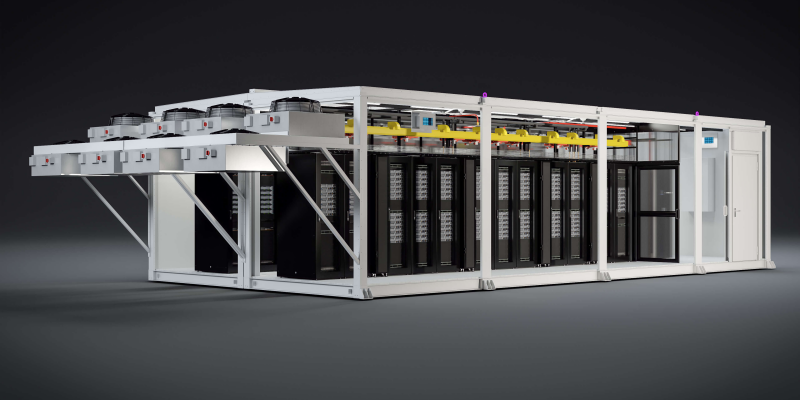
The Containerized Data Center: When IT Infrastructure Goes into a Box

Imagine being able to order your data center just like you would order a shipping container. Ninety days later, a complete infrastructure arrives at your doorstep, ready to plug in. No construction work, no endless building permits, no unpleasant surprises regarding deadlines. Welcome to the world of containerized data centers.
This solution, long reserved for web giants such as Google, is now available to businesses of all sizes. But what does this model really involve? And, more importantly, is it right for you?
What is a Containerized Data Center?
The concept in practice
A containerized data center is exactly what its name suggests: a complete IT infrastructure integrated into a standard shipping container (10, 20, or 40 feet). Think of it as a factory-built, turnkey data center.
Inside? Everything you need to run your servers: 19-inch racks, cooling systems, redundant power distribution, raised access flooring, physical security. All designed, assembled, and tested in the factory before it even arrives on your site.
Key point: Unlike a traditional data center, where you have to coordinate architects, electricians, HVAC engineers, and integrators, here everything is designed as a standardized industrial product.
Standardized doesn't mean rigid
Be careful not to confuse containerized data centers with customized modular data centers. The two terms are often used interchangeably, but there is an important distinction:
- Standard container: Prefabricated unit with standard configuration, ultra-fast deployment, customization limited to predefined options
- Custom modular: Prefabricated components assembled to your specifications, more flexible but with slightly longer lead times
In both cases, we are a long way from the traditional data center built piece by piece on site.
Who Does What in the Market?
Eclairion: France's HPC champion
Inaugurated at the end of 2024 in Bruyères-le-Châtel (Essonne), Eclairion is a textbook case. The first fully containerized data center in France, it specifically targets supercomputers and artificial intelligence.
The figures are staggering:
- 40 to 60 MW of available IT power
- 50 m² modules configurable by the customer
- Capacity to deliver in batches of 1, 2, or 3 MW as needed
- Investment of €320 million
“The advantage of modularity is that you can set up, move away, remove your machines from the container to put others in, and also change the cooling mode depending on the machines,” explains François Sabatino, President of Eclairion. This level of flexibility would be unthinkable with a traditional data center.
Rising French manufacturers
Modul Data Center (Gardanne) perfectly illustrates the rise of French players. Their value proposition is based on sovereignty: 80% of components are French and 96% European, with 100% assembly carried out at their factory in Bouches-du-Rhône. They have developed their own patented cooling technologies and promise deployment in 3 to 6 months with a very low PUE, ensuring energy efficiency.
Module-it (Nantes) capitalizes on 12 years of experience in the sector. Their approach? To radically simplify the project process. Whereas a traditional data center goes through a series of phases (APS, APD, PRO, etc.), they offer a range of pre-existing products with options. Manufacturing times are around 6 months, allowing IT departments to define their initial configuration as accurately as possible without oversizing.
International giants
Google was a pioneer with its containers capable of hosting 1,160 servers. This density demonstrates the potential of the model on a large scale.
Rittal, major German player, offers its Blue e+ solution with optimized external cooling. Available in ISO format (20 and 40 feet) or in a 3-meter wide version for greater ease of use.
Microsoft et Facebook have also been experimenting with modular solutions since 2008, notably through the Open Compute Project, which standardizes data center designs.
Key Features that make the difference
1. Deployment speed
190 days. This is the average time it takes to set up an operational containerized data center. Compare this to the 18 to 36 months required for a traditional data center.
Why the difference? Because while your building permit application is being processed by the local authorities, the manufacturer is assembling your infrastructure in the factory. No dependence on the vagaries of the construction site (weather, COVID, access controls, etc.).
For an IT department that needs to manage rapid growth or urgently replace aging infrastructure, this is a decisive advantage.
2. Cost control
With a traditional data center, you discover budget overruns along the way. Delays, changes, unforeseen events... The final TCO can skyrocket by 30 to 50% compared to initial estimates.
The container flips the logic on its head: the price quoted at the start of the project is the price you pay. Period. Factory construction eliminates most of the uncontrollable variables.
3. Scalable modularity
Is your business doubling in size? Order a second container and place it next to the first one. You can add capacity (cooling, power, racks) exactly when you need it, not three years in advance “just in case.”
This modularity solves a classic headache for IT departments: how to get the right size without overinvesting or finding yourself stuck too quickly. With manufacturing lead times of less than 6 months, you can plan ahead with peace of mind.
4. Portability
Simple question: have you ever moved a data center located in an existing building? No? There's a reason for that.
Containers are designed for transport. Reinforced hooks, strong current penetrations designed to withstand vibrations, solid frames. Are you moving your headquarters? Your data center will follow. Are you renting your premises and the lease is coming to an end? No problem.
This mobility also opens up temporary uses: one-off needs for a project, backup infrastructure, temporary production site.
5. Plug-and-play
Forget about months of coordination between different trades. The container arrives with everything: power supply, air conditioning, server racks, cabling, fire safety.
All that remains is to:
- Prepare the ground (usually concrete slab)
- Connect the power supply
- Connect the network connectivity
- Install your servers
Three weeks to be operational after delivery, compared to several months for a traditional data center.
6. Energy efficiency
Manufacturers optimize factory cooling with CFD (Computational Fluid Dynamics) simulations. The result: PUE (Power Usage Effectiveness) often below 1.3, compared to 1.5 to 2.0 for conventional data centers.
Modul Data Center even claims “very low” PUEs thanks to its patented cooling technologies. At a time when electricity accounts for up to 60% of operating costs, every tenth of a PUE counts.
The Limits You Need to Know
Let's be honest: containerized data centers are not a universal miracle solution. They have their limitations.
1. The complexity of distributed management
The more sites you have, the more you spread your problems. A centralized data center means one team, one location, and one supervision system. Ten distributed containers mean ten potential points of failure.
Even though each container has redundant power sources, a lack of security or supervision can cause localized outages that are difficult to manage. You will need to strengthen your centralized monitoring tools (DCIM) and remote intervention processes.
Key question: Do you have the resources to manage a distributed infrastructure? Or would it be better to focus your resources on a centralized data center of equivalent size?
2. Limited capacity per unit
A 40-foot container offers approximately 20 m² of usable space. You won't be able to fit 500 racks inside it. For large-scale needs, you will need to use multiple containers, with the interconnection and consistency constraints that this entails.
Eclairion solved this equation by designing an entire campus of interconnected containers. But their €320 million investment is not within the reach of all companies.
3. The trade-off between standardization and customization
Standard containers limit your choices. You are stuck with the components selected by the manufacturer: brand of air conditioning, type of racks, UPS units, etc.
If you have very specific requirements (special certifications, integration with existing equipment, strict regulatory constraints), you will probably need to opt for customized modular solutions, which are more expensive and take longer to implement.
4. The support infrastructure
A container does not float in a vacuum. You need:
- A stable concrete slab (sized to support 10 to 30 tons)
- A sufficient power supply (MV/LV depending on power)
- Heat dissipation if liquid cooling is used
- Secure access (fences, cameras, access control)
If your site is not prepared, this preliminary work may delay the project and increase its cost.
5. Maintenance and upgrades
Working in a container measuring 2.35 m wide is less comfortable than working in a 200 m² clean room. Your technicians will not particularly enjoy long shifts.
In addition, certain changes (changing cooling technology, completely reorganizing aisles, etc.) are more restrictive than in a flexible data center.
6. Perception and image
Let's be honest: presenting your management with an investment in “containers” rather than an “enterprise data center” requires some explanation. The image may seem less prestigious, even if technically the solution is sound.
This is particularly true in sectors where IT infrastructure is a selling point (hosting providers, fintech companies, etc.).
For Whom? For What Purposes?
Ideal use cases
Rapid growth: Have you doubled your business in 12 months and your data center is at capacity? Containers give you immediate breathing room.
Remote sites: Deploy IT capabilities close to your production sites, R&D centers, or regional offices without heavy construction.
Edge computing: Bringing data source computing (Industry 4.0, IoT, intelligent video surveillance) closer together with containerized micro data centers.
Temporary projects: Need infrastructure for 2-3 years while a new site is being built? Rent a container.
HPC and IA: High-density loads require specialized infrastructure. Containers allow cooling to be tailored to exact requirements.
Relevant company profiles
- Fast-growing SMEs and mid-market companies that don't want to tie up millions in a building
- Manufacturers that need IT capacity close to their production sites
- Telecom operators looking to rapidly deploy points of presence
- Hosting and cloud providers wanting to test a market before making a significant investment
- Research laboratories with occasional supercomputing needs
Less suitable profiles
If you have a stable need for 5,000 m² of data center space for the next 20 years and the budget to build it, a traditional data center remains a viable option. You will be able to optimize space and customization more effectively.
Similarly, if you are subject to very strict standards requiring custom modifications (health, defense, finance with physical safes, etc.), the standard container may not tick all the boxes.
How to Get Started?
1. Assess your real needs
Before rushing into anything, ask yourself the right questions:
- What IT power? (kW)
- How many racks?
- What redundancy (N, N+1, 2N)?
- What type of cooling based on your density?
- Physical security constraints?
- Connectivity requirements?
2. Compare offers
The market offers several levels:
- Consumer solutions: standard configurations, attractive prices but limited options
- Professional solutions: customizable, experienced manufacturers, solid support
- Custom solutions: for very specific needs, longer lead times and higher budgets
Always check:
- Certifications (ISO 27001, Tier III/IV depending on the level targeted)
- The origin and quality of components
- Warranties and after-sales support
- Customer references in your sector
3. Prepare the land
While the container is being manufactured, prepare:
- Roadworks (roads, networks, concrete slabs)
- Electrical connection (allow 6 to 12 months for a medium-voltage supply)
- Connectivity solutions (fiber optics, operator redundancy)
- Security and access procedures
4. Plan for the future
A container requires the same operational rigor as a traditional data center:
- Maintenance contracts with the manufacturer
- 24/7 monitoring (temperature, humidity, power, intrusion)
- Rapid response procedures
- Continuity plan in case of container failure
- Management of future developments
What about the Future?
The market for containerized data centers is reaching maturity. Innovations are focused on:
Liquid cooling: For HPC and AI loads exceeding 30-40 kW per rack, only liquid cooling can manage the heat. The containers are adapted with integrated circuits.
Energy independence: Coupling with solar panels, fuel cells, or storage batteries for isolated sites or those seeking carbon neutrality.
Modular hybridization: Combining containers and conventional buildings to optimize costs and flexibility according to loads.
Digital sovereignty: With French manufacturing gaining momentum, containers enable control over the value chain and compliance with regulatory requirements.
In a nutshell
Containerized data centers break the mold of traditional IT infrastructure. In 190 days, you will have an operational, transportable, scalable, and cost-controlled solution.
There are limitations: more complex distributed management, limited unit capacity, less customization than bespoke solutions. But for many companies, the advantages far outweigh the disadvantages.
Google understood this 15 years ago. Eclairion has just demonstrated it on the scale of French HPC. How about you?
Are you looking to compare different data center solutions for your project? Our Marketplace Datalok gives you a clear overview of the offerings available on the French and European markets, whether traditional colocation, modular solutions, or containerized data centers. Save time by comparing infrastructures based on your technical, geographical, and budgetary criteria.
Discover Modular data center solutions for hosting your servers.